
Introduction
In today’s highly competitive manufacturing landscape, companies engaged in high-volume part production universally face two core challenges: how to maintain micrometer-level precision while controlling costs, and how to ensure absolute consistency across thousands of parts to avoid batch rejections or production delays due to minor defects. The root cause often lies in reliance on traditional, fragmented machining processes and a lack of supplier solutions tailored for mass production, integrated with automation and real-time quality control. Solely pursuing low unit prices can compromise process stability and long-term reliability.
This article delves into how modern CNC turning applications leverage advanced technologies like CNC turning and milling centers to consolidate machining steps and implement optimization strategies for scenarios such as wholesale aluminum CNC turning parts, systematically resolving the quality-cost dichotomy in mass production. The following sections will analyze the core methodologies for achieving efficient and reliable volume manufacturing across five key dimensions.
Why Traditional Lathes Struggle to Meet Modern Precision Volume Demands?
Traditional manufacturing approaches face significant hurdles in high-volume, precision-critical environments. The limitations of manual or single-axis lathes and disjointed machining processes become major bottlenecks.
The Domino Effect and Cost of Multiple Setups
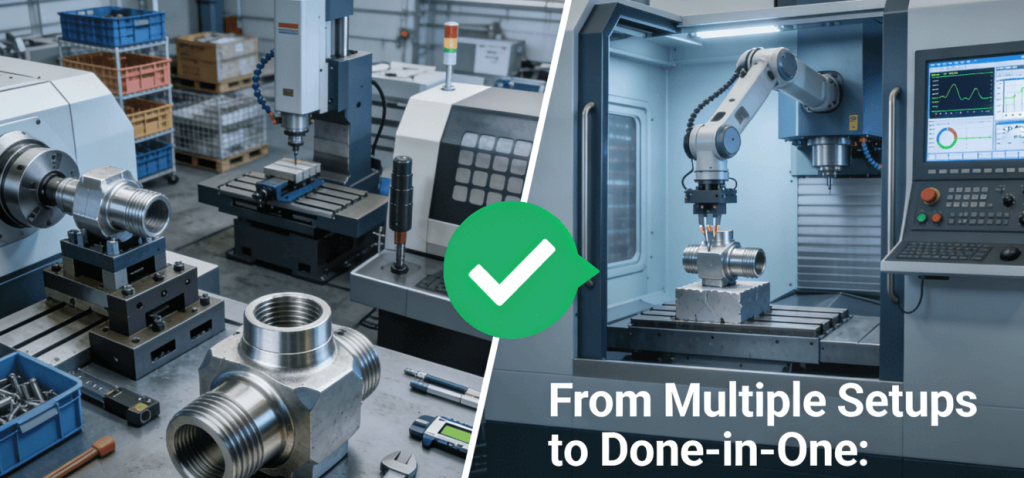
A primary issue in traditional machining is cumulative error from multiple setups. Moving a part between different machines for turning, milling, and drilling introduces small misalignments that stack up. This makes holding tight tolerances across a production run exceptionally difficult.
- The Hidden Costs
The perceived savings from simpler equipment are erased by hidden costs. Low First-Pass Yield increases scrap and rework, consuming extra material and machine time.
- Impact on Key Metrics
This process instability cripples Overall Equipment Effectiveness (OEE). Unpredictable downtime for adjustments disrupts scheduling, causing delays that ripple through the supply chain.
The Imperative for Integrated Automation
The transition to automated, integrated CNC turning applications is essential for volume production. For a stable volume CNC turning solution, understanding core applications is key. A detailed guide is here: volume CNC turning.
How CNC Turning and Milling Centers Become Game-Changers for Volume Production?
The CNC turning and milling center represents a paradigm shift. This advanced machine combines turning and milling capabilities within a single unit, allowing a workpiece to be completed in one clamping.
The core advantage is the elimination of secondary setup error. By performing turning, milling, drilling, and tapping operations sequentially on one machine, the part’s datum reference never changes. This is critical for achieving high geometrical accuracies like concentricity and positional tolerance in CNC turning milling parts. Studies show that consolidating processes can reduce part handling and queue time by over 60%, drastically accelerating production cycle time.
Beyond speed, these centers enable in-process quality assurance. Integrated touch probes can measure critical dimensions between machining steps. If a tool shows wear or a dimension drifts, the machine’s controller can automatically compensate, adjusting tool paths in real-time. This closed-loop control is fundamental for achieving the part-to-part consistency required for batch sizes of thousands or tens of thousands, making it the key technology for high-volume, complex component production.
How to Balance Ultimate Cost and Performance for Wholesale Aluminum CNC Turning Parts?
Aluminum alloys are the go-to material for wholesale aluminum CNC turning parts due to an optimal blend of lightweight properties, excellent machinability, and favorable cost. Maximizing value in this segment requires a strategic, multi-faceted approach.
Optimizing Material, Design, and Scale
Success in producing wholesale aluminum CNC turning parts hinges on strategic optimization. The first step is material-process synergy, selecting aluminum alloys that pair with high-speed machining to maximize tool life and removal rates, lowering cost per part.
- Leveraging DFM and Volume
Design for Manufacturability (DFM) is critical. Simplifying part geometry and standardizing features drastically cuts machining time and material waste, which is essential for cost-effective production.
- The Power of Standardized Finishing
For batch orders, consistent finishing like anodizing is not just cosmetic. It ensures corrosion resistance and uniform appearance across thousands of parts, a capability offered by expert suppliers like JS Precision.
The Path to Ultimate Efficiency
True economies of scale are unlocked through production line optimization and dedicated runs. This minimizes changeovers and allows for process fine-tuning, substantially driving down unit cost while maintaining high performance for volume orders.
Which Industries Have Non-Negotiable Requirements for CNC Turning?
Certain sectors demand unparalleled levels of precision, material integrity, and traceability, pushing CNC turning services to their highest capability.
Industries like aerospace, medical, and semiconductor manufacturing impose non-negotiable demands on CNC turning services. Aerospace components require machining tough materials like titanium to micron-level tolerances under extreme conditions, governed by AS9100 certification for full traceability. Medical turning demands biocompatible materials and exceptional surface finishes to ensure patient safety, guided by ISO 13485 standards. For a semiconductor CNC turning supplier, the challenge extends to ultra-cleanliness, requiring processes that prevent particle generation and ensure corrosion resistance for vacuum environments. Each field bases its rigorous specifications on advanced metrology and uncompromising quality control, defining the pinnacle of precision manufacturing.
How Should Manufacturers Evaluate and Select a High-Volume CNC Turning Partner?
Choosing the right manufacturing partner is as critical as the design itself. A systematic evaluation framework should cover technical, qualitative, and operational facets.Selecting a high-volume CNC turning services partner requires evaluating both technical capability and operational integrity. The assessment begins with verifying the supplier’s modern machinery, relevant industry certifications (e.g., IATF 16949, AS9100D), and use of Statistical Process Control for real-time quality.
Vertical integration for secondary processes enhances schedule and quality control. Crucially, partners must provide data transparency, such as FAIR and process capability studies, as proof of consistent performance. A comprehensive service portfolio and collaborative approach indicate a true long-term partner. Reviewing a supplier’s core offerings provides the clearest insight, as seen in detailed service pages like CNC turning services.
Conclusion
In summary, successful high-volume precision manufacturing is far more than simple repetition. It is the fusion of precision engineering, advanced multi-tasking equipment, stringent quality systems, and deep industry knowledge. From the efficiency revolution enabled by CNC turning and milling centers to the specialized strategies for aerospace CNC turning and medical CNC turning, every step impacts final product reliability and commercial success. Selecting a manufacturer certified to a full spectrum of standards like IATF 16949 and AS9100D signifies a commitment to process control and sustainability.
If your next project involves high-volume, high-complexity metal part manufacturing, it is time to re-evaluate your supply chain strategy. Upload your part drawings today to receive a quote based on professional DFM analysis and transparent costing, and experience a future-oriented precision manufacturing solution.
Author Bio
This article was written by a precision manufacturing and supply chain optimization expert with over 15 years of experience, focusing on providing insights into manufacturing technology solutions from prototype to volume production for global industrial enterprises. The expert is affiliated with JS Precision, a provider of on-demand custom manufacturing services.
FAQs
Q1: What is the typical accuracy range for high-volume CNC turning?
A:For production volumes, dimensional tolerances can be consistently held within ±0.01 mm. Critical features, with in-process compensation, can achieve ±0.005 mm or better. Final achievable precision depends on material, part geometry, and machine capability and should be evaluated on a case-by-case basis.
Q2: Where are the biggest cost optimization points for batch production of aluminum parts?
A:The primary levers are material utilization, cycle time optimization, and post-processing efficiency. Implementing DFM to reduce waste, employing high-speed machining strategies, and planning batch surface treatments can effectively lower the total cost per part.
Q3: What special material certifications are needed for medical or aerospace-grade turned parts?
A:Typically, certifications from the material manufacturer are required, including a mill certificate or certificate of conformity with the heat number, confirming chemical composition and mechanical properties per standards like AMS or ASTM. Full material traceability through the supply chain is often mandatory for regulatory compliance.
Q4: Why are IATF 16949 and AS9100D certifications crucial for producing automotive and aerospace parts?
A:These are industry-specific quality management system standards. IATF 16949 focuses on automotive process control and continuous improvement, while AS9100D emphasizes risk management and product safety for aerospace. They are essential for demonstrating a supplier’s capability to produce safe, reliable, and consistent parts, serving as a key entry ticket into these supply chains.
Q5: What is the typical lead time from order to receipt of the first production batch?
A:For a project that has passed the initial sample approval stage, the lead time for the first production batch is typically 3-4 weeks. This encompasses raw material procurement, production scheduling, machining, quality inspection, and logistics. Expedited options can often be negotiated for urgent requirements.