
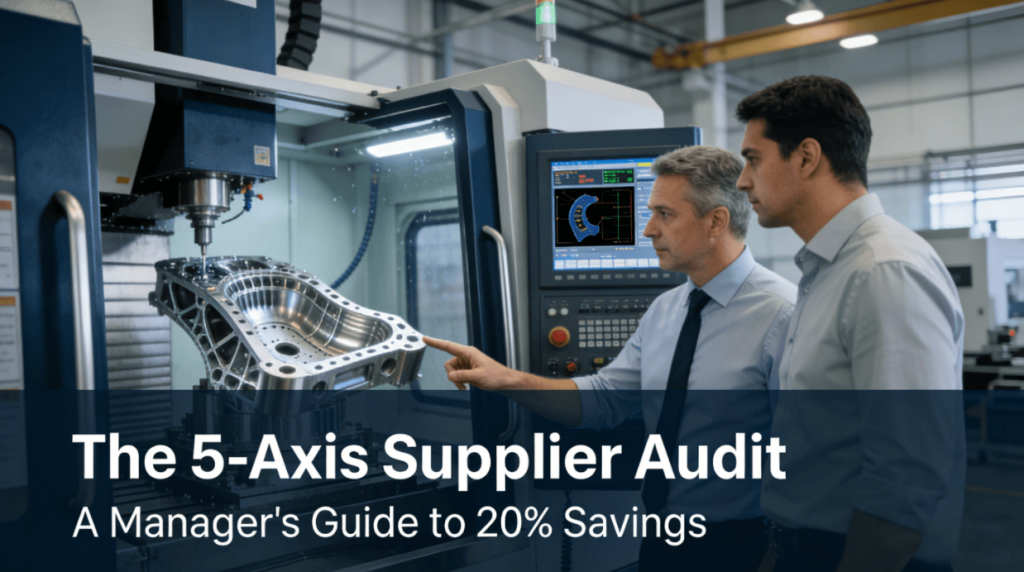
Introduction
In the world of precision engineering, the escalating complexity of components is pushing traditional 3-axis or 4-axis machining to its limits. Procurement managers are increasingly confronted with protracted lead times and stubbornly high scrap rates, as legacy methods struggle to meet stringent geometric tolerances and surface finish requirements. This bottleneck directly impacts product development cycles and erodes profitability, stalling innovation.
The root cause is a common oversight in supplier selection: an overemphasis on initial unit price that overlooks the profound impact of equipment capability and quality management systems on long-term total cost of ownership (TCO). A myopic focus on the cheapest bid often leads to hidden costs in rework, delays, and quality failures. This guide provides a strategic framework, dissecting technical capability, true cost structures, and global compliance, to demonstrate how intelligent selection of advanced CNC technology is the key to optimizing efficiency and reducing expenses in High-Tech Parts Production.
Why is Precision Engineering Shifting Toward 5-Axis Manufacturing Solutions?
The shift is driven by the uncompromising demand for complex, monolithic components in aerospace, medical, and automotive sectors, where performance is intrinsically linked to intricate geometries that defy conventional machining. Traditional multi-axis setups introduce cumulative errors and inefficiencies that 5-axis technology elegantly solves. It represents the evolution from segmented, error-prone production to integrated, high-fidelity precision engineering.
1. The Single-Setup Revolution for Ultimate Accuracy
The core advantage is the elimination of multiple setups. In conventional machining, a part must be manually repositioned and re-fixtured for each side to be machined, each time introducing a new potential for misalignment. 5-axis manufacturing solutions complete machining in one clamping, maintaining a single, constant datum reference. This fundamental shift is critical for achieving the tight positional tolerances and perfect alignment between complex features required in advanced assemblies.
2. Unlocking Unprecedented Design Freedom
With two rotational axes added to the standard three linear movements, the cutting tool can approach the workpiece from virtually any angle. This enables the machining of deep cavities, undercuts, and compound curved surfaces in a single, continuous operation. This geometric freedom allows designers to consolidate what was once an assembly of multiple parts into a single, stronger, lighter, and more reliable monolithic component, driving true Industrial Innovation.
3. Beyond Complexity: Tangible Performance Gains
The benefits extend beyond just making the impossible possible. By allowing the use of shorter, more rigid cutting tools and maintaining an optimal cutting angle, 5-axis machining produces superior surface finishes, extends tool life, and enables higher material removal rates. This translates to parts that not only meet design intent but also exhibit better fatigue life and functional performance, a cornerstone of modern Custom Manufacturing.
How Does 5-Axis CNC Machining Cost Structure Impact the Total Project Budget?
While the hourly machine rate for 5-axis machining may appear higher, its true economic advantage lies in a transformative cost structure that reduces the total project budget by consolidating operations, minimizing non-value-added time, and slashing indirect expenses. A holistic view beyond the initial quote reveals that it is a powerful driver of cost-effective machining.
- The True Cost of Multiple Setups: Every time a part is re-fixtured, costs accumulate in often-overlooked areas: labor for manual handling, engineering time for designing and fabricating multiple custom fixtures, and quality inspection at each stage. More critically, each setup introduces the risk of human error and datum misalignment, leading to scrap and rework. The consolidated 5-axis CNC machining cost model inherently eliminates these redundant steps and their associated risks and expenses.
- Direct Savings in Tooling and Labor: A significant portion of savings comes from the drastic reduction in specialized fixturing. A single, often simpler, fixture replaces several complex ones, saving on design, material, and manufacturing costs. Furthermore, with the machine running unattended for longer periods to complete a part, direct labor input per component is significantly reduced. This operational efficiency is a key factor in achieving the promised 20%+ savings.
- The Holistic Economic Model: The most compelling financial argument is the acceleration of time-to-market and the reduction of lifecycle costs. Faster prototyping allows for more design iterations. Lower scrap rates in production conserve expensive materials. Consolidated parts reduce assembly and inventory costs. For a detailed economic comparison, managers can refer to this in-depth guide on 5-axis CNC parts manufacturing, which breaks down the total cost of ownership for complex components.
What Role Do International Standards Play in Industrial Innovation and Quality Assurance?
International standards are not mere bureaucratic checkboxes; they are the codified DNA of a reliable manufacturing process, providing a predictable framework that de-risks innovation and ensures supply chain resilience. In high-stakes industries, these standards are the minimum viable foundation for trust and consistent quality assurance.
1. The Language of Precision: ASME Y14.5
Effective communication of design intent is impossible without a universal language. The ASME Y14.5 standard for geometric dimensioning and tolerancing (GD&T) provides this. It allows designers to precisely specify how a part must function, not just its dimensions. A supplier fluent in this language can accurately interpret complex drawings, ensuring the manufactured part performs as intended, which is fundamental to successful Supply Chain Selection for precision components.
2. The System of Reliability: ISO 9001 and Beyond
While ASME Y14.5 dictates what to make, ISO 9001 defines how to make it consistently. This quality management standard mandates a process-oriented approach with documented procedures, corrective actions, and continuous improvement. For sectors like automotive (IATF 16949) or aerospace (AS9100D), these requirements are even more rigorous, enforcing statistical process control (SPC) and full traceability. This systematic approach is what transforms a workshop into a predictable partner for Industrial Innovation.
3. Certification as a Risk Mitigation Tool
For a procurement manager, a supplier’s certification is a pre-verified risk mitigation report. It signals that the supplier has invested in systems to prevent errors rather than just inspect them out. It ensures that quality is engineered into the process, dramatically reducing the risk of late-stage failures, batch rejections, and production line stoppages that far outweigh any initial price savings from an uncertified source.
How to Evaluate a Supplier’s Capacity for Complex Part Manufacturing?
Evaluating a 5-axis supplier requires moving beyond a checklist of machine brands to a holistic audit of their technological ecosystem, problem-solving culture, and process integration capabilities. True capacity for complex part manufacturing is a combination of hardware, software, and human expertise.
1. The Hardware-Software Symbiosis
Owning a 5-axis machine is a starting point, not a guarantee. The critical differentiator is the advanced CAM software (e.g., Siemens NX, HyperMill) and the programmer’s skill in using it. Inquire about their toolpath optimization strategies, simulation fidelity for collision detection, and post-processor development. The ability to generate efficient, reliable code for complex geometries is what unlocks the machine’s potential for your high-tech parts production.
2. The Engineering Partnership Mindset
The ideal supplier acts as an extension of your engineering team. During the quoting process, do they provide a Design for Manufacturability (DFM) analysis? Do they proactively suggest material or geometry alterations that improve robustness or reduce cost? This collaborative, problem-solving approach is more valuable than a passive “print-to-part” service. It demonstrates a depth of experience that safeguards your project.
3. Metrology and Process Control
Precision machining is meaningless without precision measurement. Assess their in-process and final inspection capabilities. Do they use on-machine probing for real-time adjustment? What level of CMM (Coordinate Measuring Machine) or laser scanning technology do they employ for first-article inspection? A robust metrology infrastructure, integrated with a quality management system, is the final assurance that the physical part matches the digital design.
Why Is Advanced CNC Technology the Backbone of Modern Supply Chain Selection?
In an era demanding supply chain agility and resilience, selecting a manufacturing partner with advanced technological capabilities is a strategic decision that impacts far more than unit cost; it determines your company’s speed, flexibility, and ability to innovate. Advanced CNC technology is the cornerstone of a responsive and robust supply chain.
1. Accelerating Time-to-Market and Enabling Agility
The ability to produce complex prototypes and end-use parts in dramatically shorter timelines is a direct competitive advantage. 5-axis machining compresses the production cycle, allowing for faster design validation and quicker market entry. Furthermore, it provides unparalleled flexibility to accommodate engineering change orders (ECOs) late in the design process without requiring entirely new fixtures or tooling.
2. Reducing Supply Chain Complexity and Risk
By enabling part consolidation, advanced machining reduces the number of individual components, suppliers, and assembly steps required. This simplification minimizes logistical complexity, quality interfaces, and potential points of failure. It brings more of the value-creation process in-house with a single, highly capable partner, enhancing supply chain control and transparency.
3. Future-Proofing Your Product Pipeline
Partnering with a technologically forward supplier future-proofs your product development. As designs evolve to be lighter, stronger, and more integrated, you have a partner already equipped to manufacture them. For companies seeking to build this strategic advantage, prioritizing suppliers that offer comprehensive 5-axis CNC machining services ensures a seamless path from prototyping to volume production, turning manufacturing from a constraint into an enabler.
Conclusion
Selecting a precision manufacturing partner is not a simple procurement exercise but a strategic evaluation of technical depth, process stability, and quality maturity. By strategically integrating advanced 5-axis CNC technology, companies can overcome the bottlenecks of complex part manufacturing, unlock new design possibilities, and gain a competitive edge through reduced total cost of ownership and enhanced supply chain resilience. The right partner becomes a catalyst for innovation, not just a vendor.
FAQs
Q1: What are the primary advantages of choosing 5-axis machining over traditional methods?
A: The primary advantages are single-setup machining that eliminates cumulative alignment errors, superior ability to handle complex geometries with undercuts and deep cavities, and the production of better surface finishes with more stable, shorter cutting tools, all contributing to higher accuracy and efficiency.
Q2: How does a manufacturer’s ISO certification impact my project’s risk profile?
A: Certifications like ISO 9001 or IATF 16949 validate a systematic, process-driven quality management system. This ensures full traceability, consistent procedures, and proactive error prevention, drastically reducing risks of batch failure, rework, and supply chain disruption for your project.
Q3: Why is 5-axis CNC machining cost often perceived as higher, and is it worth it?
A: While the hourly rate may be higher, 5-axis technology reduces total cost by eliminating multiple fixtures, reducing manual labor and handling, and lowering scrap rates. For complex parts, this consolidation often results in a lower total project cost and faster completion, providing strong ROI.
Q4: Can 5-axis technology handle all types of materials used in Industrial Innovation?
A: Yes, modern 5-axis centers are capable of machining everything from aluminum and stainless steel to high-temperature alloys like Inconel and composites. The key is the supplier’s expertise in optimizing cutting parameters, tooling, and coolant strategies for each specific material to ensure integrity and precision.
Q5: What should be the first step in how to choose a 5-axis CNC supplier?
A: The first step is a technical and operational audit. Beyond checking machine brands, evaluate their CAM software capability, quality inspection metrology, and relevant industry certifications (e.g., AS9100D, ISO 13485). Request a detailed DFM analysis on a sample part to assess their engineering partnership approach.
Author Bio
The author is a manufacturing solutions strategist with deep expertise in advanced machining technologies. The insights shared are based on extensive experience in partnering with engineering teams to overcome complex production challenges and optimize supply chains for performance and cost. For a professional assessment of your specific project’s manufacturability and potential cost-saving strategies, you can request a complimentary design for manufacturability (DFM) analysis from the engineering team at LS Manufacturing.